|
| The liverwort genera (Bryophyta: Hepaticae and Anthocerotae) of Britain and Ireland |
Gametophyte. Plants leafy (with erect stems and oblong, simple leaves). The stems erect, arising from a horizontal, simple or branched rhizome. The stems with cortical cells clearly differentiated from the cells of the central strand (the cells all thin walled, those of the 4-stratose cortex containing chloroplasts and oil bodies). Ostensibly acrogynous (in that the archegonium develops adjacent but proximal to the three-sided apical cell). The leaf cells without trigones. Rhizoids absent.
The leafy shoots radially symmetrical, with three ranks of similar and more or less equal sized leaves to dorsiventral, with two equal ranks of lateral leaves and a third, ventral rank of smaller underleaves (isopyllous to subisophyllous, the leaves transversely inserted, concave and varying from lingulate to ovate-rhomboidal, their apices obtuse to acute, one or both sides often with a small lobe, those of the antical row slightly smaller). The vegetative leaves without vittae. The cells of the gametophyte with numerous small chloroplasts. Gemmae absent.
The plants dioecious.
Male inflorescences towards the stem apices of male plants. The antheridia scattered over the stem and in the axils of bracts. Perigynium absent or vestigial. Bracteole absent. Perianth absent. Calyptra present and well developed (formed partly by upgrowth from the archegonial stalk, and partly from the venter).
Sporophyte. The sporophyte elevated by elongation of the seta, with no intercalary meristem. The capsule shortly cylindrical. The capsule wall 1 layered (with brown, longitudinal annular thickenings). The capsule 2–4 valved, but dehiscing via a single longitudinal slit. Elaters present; bispirally thickened (mostly), or unispirally thickened and bispirally thickened; free and persistent on elaterophores (some attached to the valve apices, others - relatively broad, short and often monospiral - at the base of the capsule). The elaterophores (assuming these are represented by obscure basal and apical thickenings of the capsule wall) basal and apical (descriptions seen being ambiguous ...).
British representation. 1 species (H. hookeri); England, Wales, and Scotland.
Classification. Class/Division Hepaticae. Subclass/Class Jungermanniidae (Haplomitriopsida of Forrest et al.). Order Calobryales. Family Haplomitriaceae.
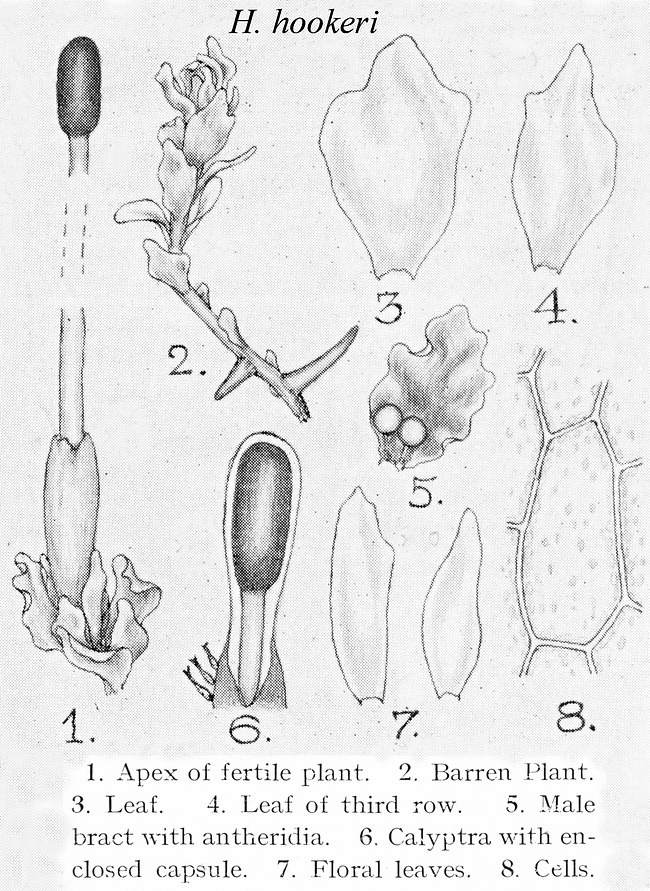
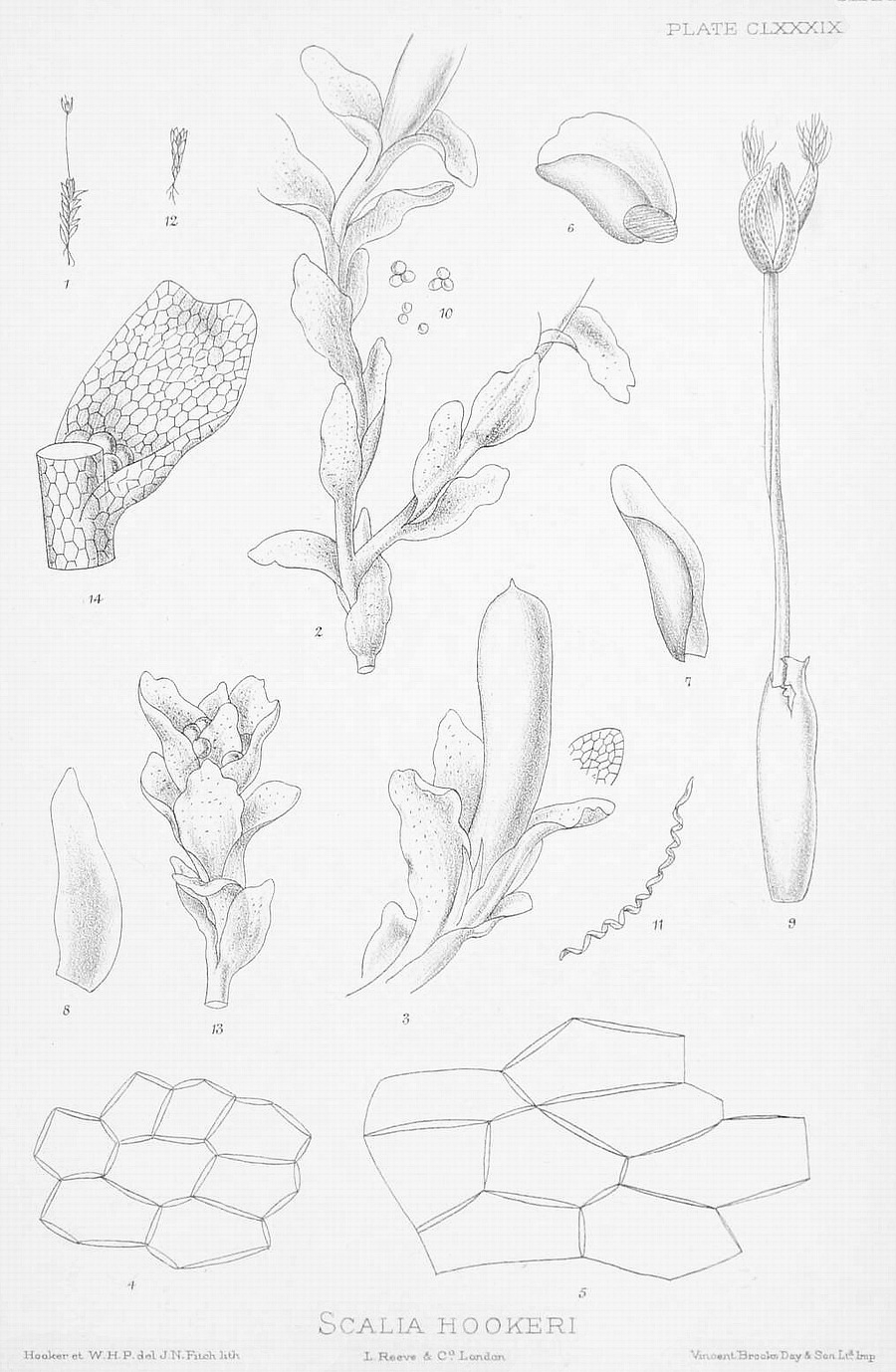
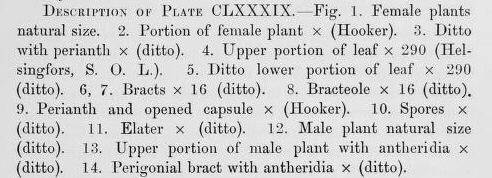
Illustrations. • H. hookeri: Jameson, in Macvicar (1926). • H. hookeri (as Scalia hookeri): Pearson fig. CLXXXIX (1902). • H. hookeri (as Scalia hookeri): Pearson fig. CLXXXIX legend.
We advise against extracting comparative information from the descriptions. This is much more easily achieved using the DELTA data files or the interactive key, which allows access to the character list, illustrations, full and partial descriptions, diagnostic descriptions, differences and similarities between taxa, lists of taxa exhibiting or lacking specified attributes, and distributions of character states within any set of taxa. See also Guidelines for using data taken from Web publications.
Cite this publication as: ‘Watson, L., and Dallwitz, M.J. 2005 onwards. The liverwort genera (Bryophyta: Hepaticae and Anthocerotae) of Britain and Ireland. Version: 5th August 2019. delta-intkey.com’.